Product
Solid State Relay 40A- KRES40C -Kayama
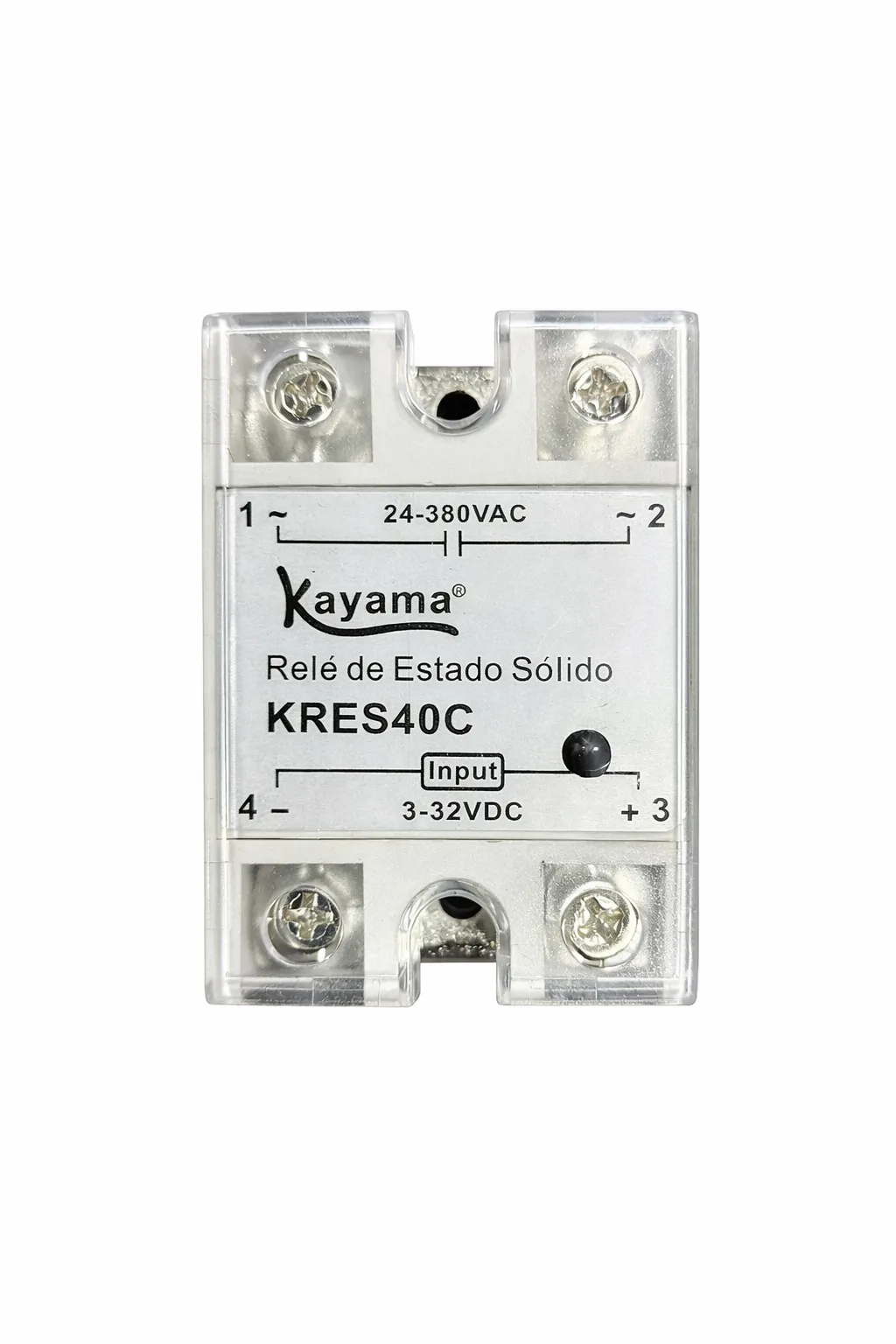
Kayama KRES40C 40 A Solid State Relay SSR with 3–32 VDC input and 24–380 VAC output
The Kayama KRES40C Solid State Relay is an SSR designed for electronic switching of AC loads, featuring a 3–32 VDC control input, 24–380 VAC output and stated rated current of up to 40 A. It features stated internal optical isolation, LED indicator and panel mounting.
- SKU
- 07130028
- Category
- Solid State
Talk to a specialist
Our team of consultants can help with specification and sizing.
Technical Description
The Kayama KRES40C Solid State Relay SSR is an electronic device designed to switch alternating-current (AC) loads using a direct-current (DC) control signal.
The model features a 3–32 VDC control input, 24–380 VAC load output and stated rated current of up to 40 A, allowing integration into electrically compatible control and automation systems.
By using semiconductor components in the power stage, the KRES40C performs switching without the conventional mechanical contacts found in electromechanical relays.
Technical Characteristics
- Brand: Kayama
- Model: KRES40C
- Type: Solid State Relay — SSR
- Control input: 3–32 VDC
- Control type: DC
- Output voltage range: 24–380 VAC
- Output type: AC
- Stated rated current: up to 40 A
- Internal optical isolation: stated
- LED indicator: stated
- Mounting: panel mounting
- Switching technology: solid state
- Purpose: electronic switching, control and automation
Operating Principle
The KRES40C uses semiconductor components to electronically establish or interrupt current conduction in the power circuit.
When a compatible signal is applied to the 3–32 VDC control input, the internal circuit activates the power stage and switches a compatible load connected to the 24–380 VAC output.
Because power switching does not rely on conventional mechanical contacts, the solid-state relay eliminates the mechanical wear associated with opening and closing such contacts.
3–32 VDC Control Input
The KRES40C control input is specified for 3 to 32 VDC signals.
This allows integration with different electronic control systems provided that both control voltage and available output current are electrically compatible.
A voltage within this range alone should not be considered proof of compatibility with every controller. The electrical interface must be evaluated before installation.
24–380 VAC Output
The power output is designed to switch AC loads from 24 to 380 VAC.
Therefore:
- 3–32 VDC: control circuit;
- 24–380 VAC: power circuit.
The DC control input does not mean the output is intended for switching DC loads.
40 A Rated Current
The model has a stated rated current of up to 40 A.
This rating should not be considered independently when determining the actual usable current for an installation.
Selection should consider:
- load type;
- operating current;
- starting or surge current;
- ambient temperature;
- ventilation;
- thermal dissipation;
- switching frequency;
- duty cycle;
- mounting method;
- project safety margin.
Thermal Behavior
Solid-state relays generate heat in the semiconductor power stage while conducting current.
Proper thermal design is therefore essential, particularly at higher operating currents.
Depending on actual operating conditions, installation on a properly sized heat sink may be required.
Heat dissipation should be sized according to actual load current, ambient temperature, ventilation, duty cycle and mounting conditions.
Optical Isolation
The KRES40C is stated to have internal optical isolation.
This feature provides functional separation between the electronic control circuit and power stage.
No specific isolation voltage should be stated without supporting technical documentation.
LED Indicator
A stated LED indicator assists in identifying the control circuit status.
The LED must not be used as the sole method of confirming that a circuit is de-energized or safe for servicing.
Load Characteristics
The behavior of an SSR depends on the characteristics of the connected load.
Resistive loads can behave differently from motors, transformers, solenoids, capacitive loads and electronic power supplies.
Loads with high starting or surge current require appropriate analysis, and the relay should not be selected solely from the load's normal operating current.
Electrical Protection
The KRES40C does not replace circuit breakers, fuses or other required electrical protection devices.
Protection must be selected according to the power supply, load and installation characteristics.
Control System Integration
The 3–32 VDC input allows the KRES40C to be considered for use with various electronic control systems.
Before connection, verify:
- controller output voltage;
- available control current;
- SSR input requirements;
- control logic;
- required isolation;
- characteristics of the controlled load.
An appropriate intermediate interface should be used when necessary.
Mounting
The KRES40C is designed for panel mounting.
Installation should provide suitable mechanical fastening, electrical connections, ventilation and thermal dissipation.
Installation and Safety
Installation should be performed by technically qualified personnel.
Before energizing, verify control voltage, load voltage, load current, load characteristics, electrical protection, thermal dissipation, connections and panel safety.
Disconnect and verify absence of voltage before installation or maintenance and allow the relay and heat sink to cool when applicable.
The KRES40C should not be used by itself as a functional safety device for machinery or processes.
Registration Information
- Brand: Kayama
- Model: KRES40C
- Rated current: 40 A
- Control input: 3–32 VDC
- Output: 24–380 VAC
- GTIN/EAN: 7900370024558
Kayama Quality
The KRES40C Solid State Relay is part of Kayama's range of components for electrical control and automation, providing electronic switching of AC loads through a DC control signal.
The Kayama KRES40C 40 A Solid State Relay can be integrated into automation systems requiring electronic switching of AC loads compatible with its operating range.
- Electric heating element control — can electronically switch compatible resistive heating elements when voltage, current and thermal dissipation are properly sized.
- Ovens and heating systems — can be incorporated into the power stage of systems using controllers to operate resistive loads.
- Temperature control — can operate as an electronic switching element between a compatible controller and a heating load.
- Industrial automation panels — can serve as an electronic interface between DC control circuits and AC loads.
- Electronic controller systems — the 3–32 VDC input allows integration when the controller output has compatible electrical characteristics.
- Repetitive switching processes — solid-state technology can be used in systems requiring frequent switching while respecting electrical and thermal limits.
- Industrial machinery and equipment — can be integrated into control and power circuits when the load characteristics remain within the SSR and project limits.
- Process automation — can electronically switch AC loads according to a compatible control logic.
Be the first to review this product.